Safeguarding Adults Week 2026
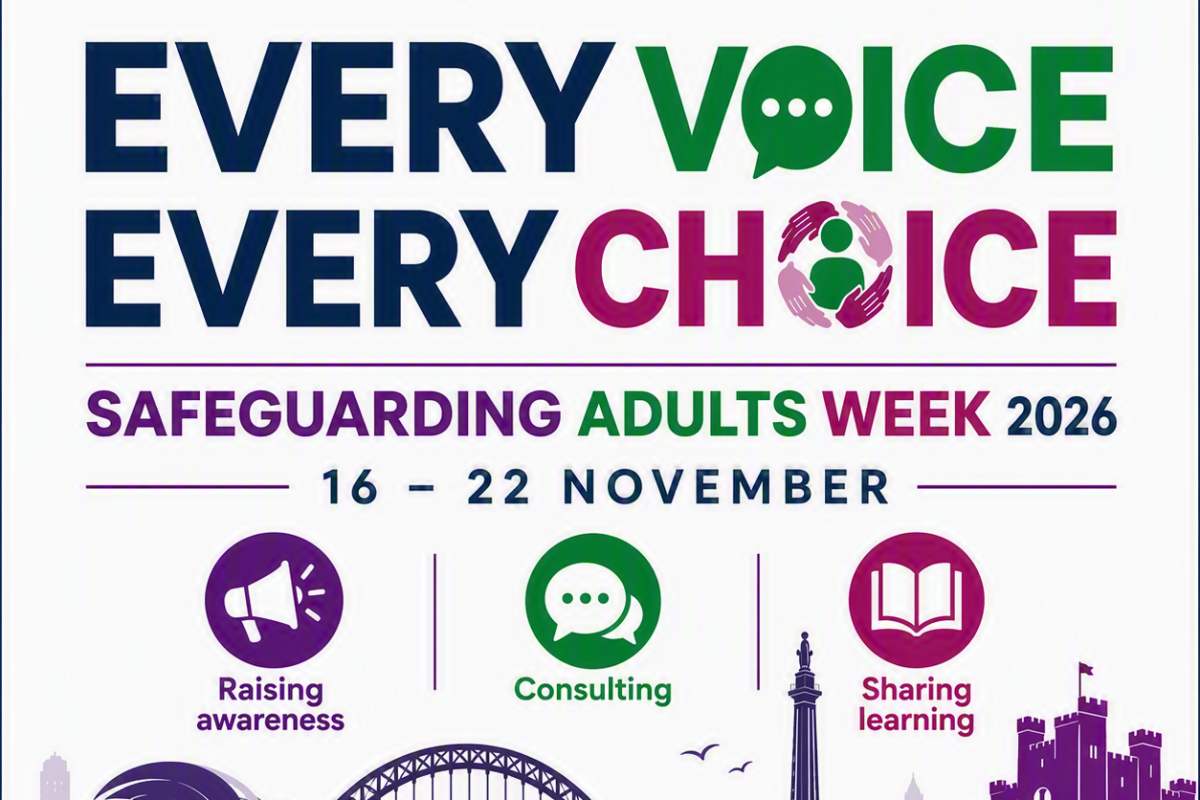
16-22 November is national Safeguarding Adults Week where organisations across the country come together to raise awareness of important safeguarding adults issues.
In Newcastle, the Board’s Improving Practice Committee is hosting (or involved in) a number of webinars and events to promote safeguarding adults best practice. The schedule below lists the different opportunities to get involved and includes links to book, register an interest or join.
To find out more about each session and to book on, please use the links in the table below.
| Date | Time | Topic | Registration | |
| 16 Nov 2026 | 09.30-16.00 | MCA and Safeguarding Adults Masterclass (Webinar) A Specialist Masterclass with Neil Allen, Barrister, 39 Essex Chambers This webinar will explore complex safeguarding scenarios involving autonomy, intervention, risk, and the application of the Mental Capacity Act 2005. | Book | |
| 17 Nov 2026 | 13.00-14.00 | Pressure Ulcers and Safeguarding Adults (Webinar) Co-hosted with Convatec for practitioners across the North East and North Cumbria. To support Stop the Pressure Week a webinar designed to build confidence around pressure ulcer prevention, management, and safeguarding adult referrals. | Book | |
| 18 Nov 2026 | 09.30-10.30 | Adult Exploitation: Practical Tools for Practice (Webinar) A short, practical webinar highlighting the tools and resources available to help practitioners recognise and respond to adult exploitation. We’ll look at how to use the Adult Exploitation Checklist in practice, alongside the referral pathway and language guidance, to support professional curiosity, identify risk and use clear, non-victim-blaming language. | Book | |
| 18 Nov 2026 | 13.30-15.00 | Making Safeguarding Personal: findings of the SAFE project study of the experiences of Older People, Family Members and Practitioners Hosted by Tees University as part of their Enhancing Older Care for Older People (EnCOP) webinar series, this presentation shares the results of a three-year study of the experiences of older people regarding safety and safeguarding. Through workshops, interviews and focus groups, experiences were gathered from older people, supporting family members, social workers and advocates. The results show a range of experiences but with some clear opportunities for practice improvement. Content is aimed at anyone working with older people as well as those directly involved in adult safeguarding, those who may find themselves in a position to make referrals for safeguarding and those supporting older people in safeguarding situations. You can join the webinar on the day using the link on the right but but we would appreciate if you would register you intention to attend via EnCOP@tees.ac.uk and a direct diary invite will be sent. | Join webinar | |
| 18 Nov 2026 | 18.30-20.00 | Safeguarding Adults in Sport Awareness Event (in-person, Gateshead Leisure Centre) Co-hosted with RISE, for sports clubs in Northumberland, Tyne & Wear and Durham. A great opportunity to increase your awareness of how to keep adults safe in your sports club, the signs to look out for if someone may be at risk of abuse, and what to do if you have any concerns. This will be an informal evening where we can discuss scenarios and examples to help build confidence in knowing what to do; and with plenty of opportunities for questions. | Book | |
| 19 Nov 2026 | 09.30- 10.30 | People’s experiences of the safeguarding adults process to inform practice (Webinar) Hear an overview of feedback from adults at risk and their representatives – what they think works well and what could be improved. | Book | |
| 19 Nov 2026 | 12.30-14.00 | Discriminatory Abuse Practice Toolkit: Making Safeguarding Equitable – Launch (webinar) National webinar hosted by the Local Government Association and Partners in Care and Health providing an overview of the toolkit and how it can support practitioners to recognise and respond to discriminatory abuse. Speakers will also share examples of how the approach has been used in practice. | Book | |
| 19 Nov 2026 | 13.00 – 14.00 | Safeguarding Adults Decision Support Guidance (Webinar) An overview of the recently launched guidance that supports good quality, proportionate safeguarding adult referrals. This guidance replaces the previous Risk Threshold Tool. | Book | |
| 19 Nov 2026 | 14.30-15.30 | Whose Safety? Whose Choice? Whose Voice? (Webinar) Hosted by Your Voice Counts for practitioners across Newcastle and Gateshead. Learn about how independent advocacy supports person-centred adult safeguarding by respecting people’s choices, understanding the influences behind their decisions and ensuring they can meaningfully participate in processes that affect their lives. | Book | |
| 20 Nov 2026 | 11.30-12.30 | Self-neglect and diabetes (Webinar) Delivered by Northumbria Healthcare NHS Foundation Trust and The Newcastle upon Tyne Hospitals NHS Foundation Trust, this workshop will explore the relationship between self-neglect and diabetes, considering how unmet health needs, barriers to engagement, and deteriorating self-care can increase the risk of harm. The session will examine the challenges practitioners face when supporting individuals who are reluctant or unable to manage their condition, alongside the importance of person-centred, multi-agency approaches to reducing risk and improving outcomes. Drawing on practice experience and learning from reviews, the workshop will highlight key considerations for recognising, assessing and responding to self-neglect in adults living with diabetes. | Book | |
| 20 Nov 2026 | 1-2pm | Trauma Informed Practice in Advocacy and Safeguarding (Webinar) Delivered by Your Voice Counts for practitioners across Newcastle and Gateshead. Understanding trauma, recognising its impact and creating safer, more empowering professional relationships. | Book |
Discriminatory abuse is a recognised category of abuse under the Care Act 2014. It includes harassment, bullying, unfair treatment or victimisation based on characteristics such as disability, race, religion, age, sex or sexual orientation.
Recent local work has highlighted that practitioners may not always identify discriminatory abuse as a safeguarding issue in its own right. Abuse may instead be recorded as emotional, physical or financial abuse, missing important opportunities to understand the person’s experience and the wider pattern of discrimination. The NSAB is interested in finding out more about practitioner experiences of identifying and responding to discriminatory abuse so we can improve training and guidance in this area. We would be grateful if you would take 5 minutes during Safeguarding Adults Week to complete our short survey: